Inside the I.C.E. Battery V1: Solar Power Stored as Ice
The I.C.E. (Integrated Cold Energy) Battery stores cold instead of heat. The first working pilot went in at the Bien Hoa farm in January 2025: a commercial 500 kg immersion ice-block maker runs on about 2 kW of AC from a solar inverter during the day, and at night a small pump sends the cold brine through PTFE lines to a modified wall split unit. The story behind it is in Introducing the ICE Battery (Part 1) and the Eureka moment (Part 3).
1. Physics Estimates: 500 kg of Ice to ~52 kWh of Cold
These figures are estimates from textbook properties, not logged measurements. Most of the cold sits in the phase change from water to ice:
Charge: ~2 kW Average, 3.7 kW Peak
The compressor draws up to 3.7 kW and cycles on and off, so the machine averages about 2 kW AC from the solar inverter. A full day of freezing uses roughly 48 kWh of electricity and fills 50 moulds of 10 kg each, with the brine bath held below -21°C.
Discharge: A Pump and a Fan, No Compressor
Brine leaves the tank near -20°C, runs through the coil of the modified indoor unit, and returns warmer. At about 3.5 kW of cooling a full charge lasts roughly 15 hours. Once the ice starts melting the brine settles near 0°C, which still gives cool air at around 10 to 15°C.
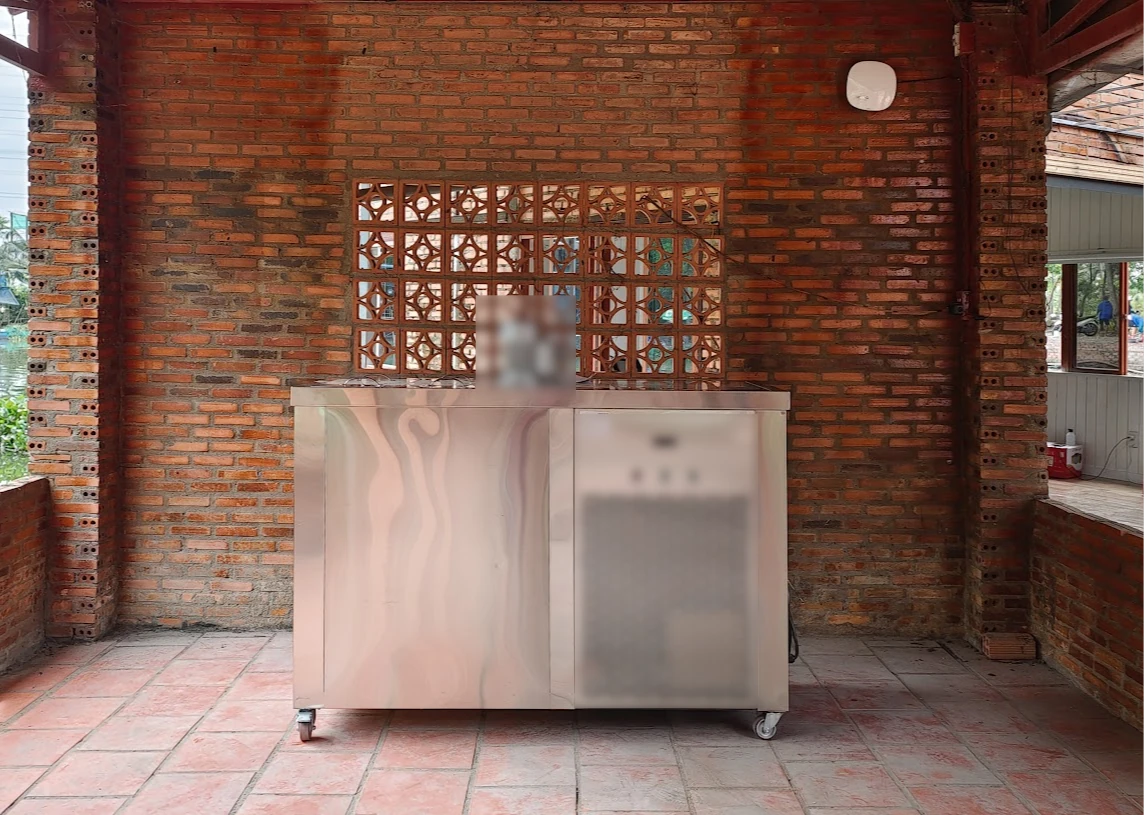
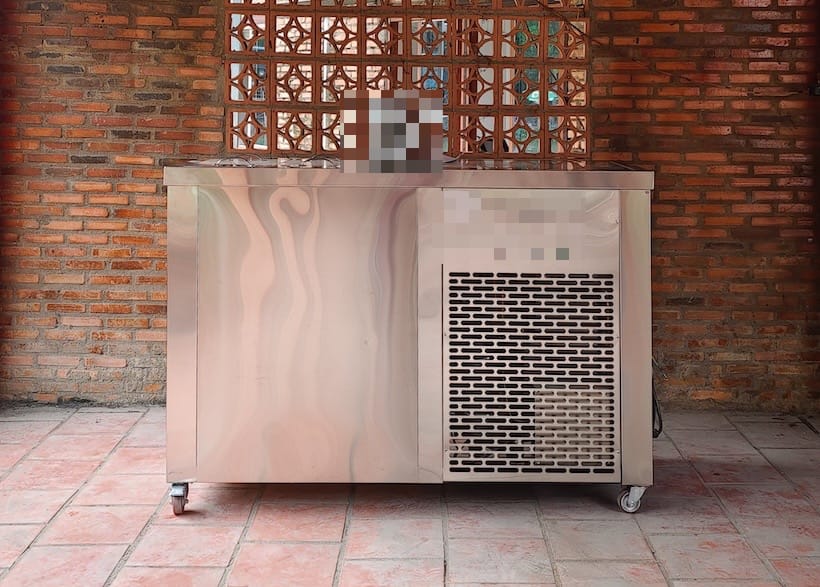
2. Real Hardware Photos (Jan 2025, Bien Hoa)
The 3D model above was built from these photos of the pilot unit and the cabinet dimensions (1630 x 1160 x 1200 mm).
3. Frequently Asked Questions
How much cold does the I.C.E. Battery V1 store?
About 52 kWh of thermal cold, an estimate from physics. Freezing 500 kg of water takes out 46.4 kWh of latent heat (334 kJ/kg), and chilling the ice from 0°C down to -20°C adds about 5.8 kWh of sensible cold.
Why use a modified split aircon on the discharge side?
The wall unit already has a finned coil and a quiet fan sized for a room. With its refrigerant circuit removed, cold brine from the tank runs through the same coil, so cooling the room takes one small pump and a fan instead of a running compressor.
Why PTFE (Teflon) tubes for the coolant loop?
PTFE stays flexible and does not crack at -20°C, and it does not react with salt brine. The lines are wrapped in white foam insulation so the cold reaches the wall unit instead of the air around the pipes.
How long can it cool a room?
At a typical 1.5 HP indoor unit load of about 3.5 kW, a full 52 kWh charge lasts roughly 15 hours. The brine starts near -20°C and settles close to 0°C while the ice melts, so the air coming out of the unit warms slowly through the night.