The Future Languages for the One-Person Dev Team: Why HTML, JS/TS, CSS, and SQL Win in the AI Era
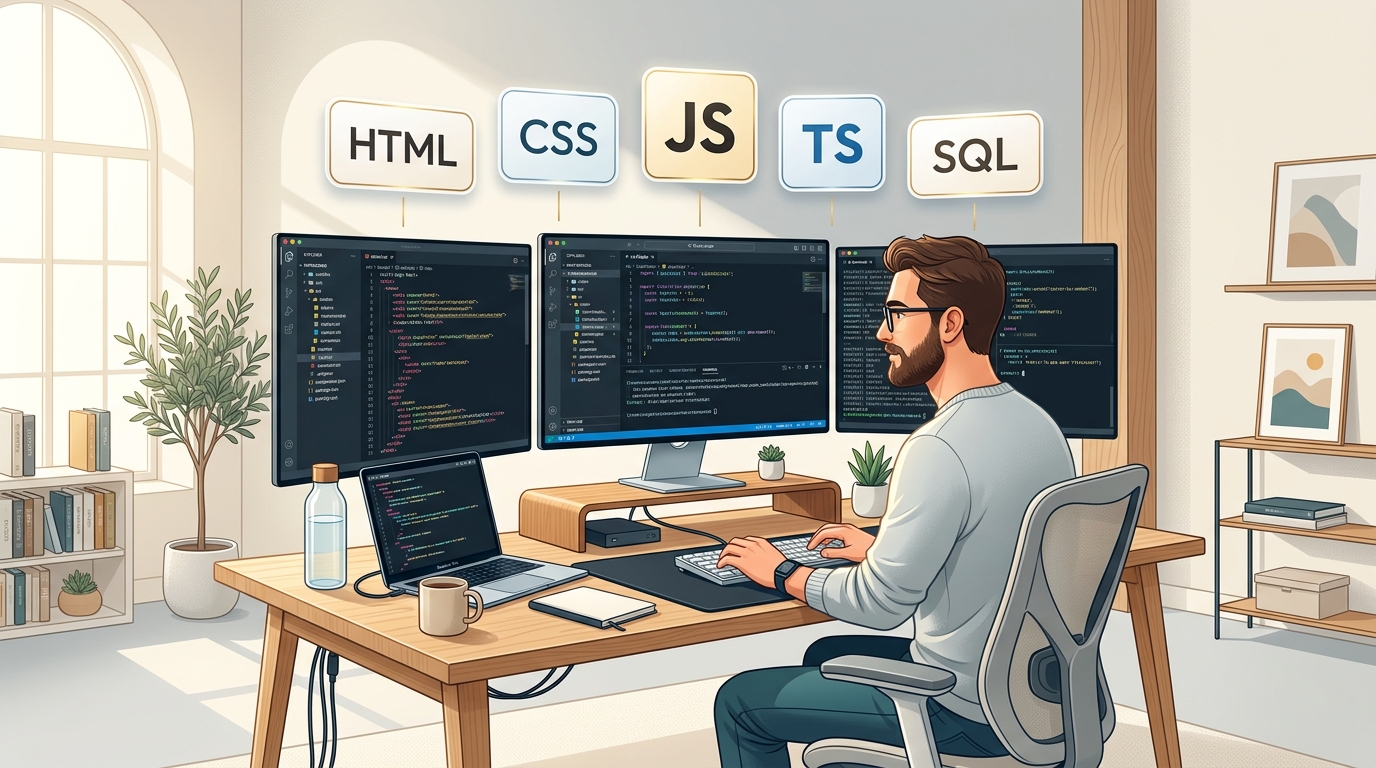
In a previous post about the lean stack, I talked about cutting out modern frontend bloat. But if you watch how software actually gets built in 2026 with AI tools like Antigravity, Claude, and Gemini, something bigger becomes obvious: the future languages of AI are the oldest languages on the web.
When an AI coding assistant builds you an interface, renders a dashboard, or formats data for a human to read, what does it actually output? Standard HTML. Not some proprietary UI schema, not compiled bytecode. Just plain, semantic markup.
Think about that for a second. Languages from the 1990s are the foundation of the 100x developer workflow today.
From <MARQUEE> to Netscape: Where It All Started
I still remember the first line of web code I ever wrote in the late 90s: the <marquee> tag. I opened that file in Netscape Navigator and watched the text scroll across the CRT screen. That was the definition of cool. Shortly after came <div>, <p>, <b>, <i>, and of course <font color="...">.
Then JavaScript showed up. JS by itself was clunky back then, but when jQuery and Bootstrap CSS came along in the 2000s, oh man, that was a game changer. You dropped a script tag and a stylesheet into an HTML file, hit refresh, and you could build anything. No bundler. No build step. No waiting five minutes for npm install.
The natural next evolution of JavaScript is TypeScript. TypeScript brings the type safety and explicit contracts that AI coding agents thrive on. When an LLM sees clear types and interfaces, it stops hallucinating property names or passing undefined variables. And with modern engines like Bun, TypeScript runs natively right out of the box with zero build setup.
Over the next fifteen years, the industry somehow convinced itself that simplicity was amateur. We replaced single HTML files with 500MB node_modules folders, hydration mismatches, server-component boundary errors, and fragile CI/CD pipelines that break if you look at them wrong.
FoxPro, Windows 3.11, and SQL: My 25-Year Superpower
My backend story started way before cloud databases existed. In my early teens, I was writing desktop software that ran inside Windows 3.11 using FoxPro. FoxPro was brilliant, fast, and purpose-built for working with data. Then Microsoft acquired it and, well, made it worse.
Here's the thing most people don't realize about FoxPro: at a time when "real" databases meant Oracle or DB2 running on expensive mainframe hardware, FoxPro stored everything in simple .dbf files right on your local disk. One machine, one file, full SQL queries. No server process, no network, no DBA required. A teenager on a 486 could build and run a complete data-driven application. That concept stuck with me.

Despite FoxPro's sad ending, it taught me something incredibly valuable at an early age: SQL.
I got hooked on relational queries as a kid, and today in my 40s, I still write and read SQL every single day. If you want to know what language will still be running critical systems in 2035 and 2045, I'm not bluffing: bet on SQL.
AI models are scary good at SQL. Give an LLM a clean schema with proper foreign keys and constraints, and it writes complex joins like it's nothing. ORMs and trendy query abstractions just add noise between the model and your data.
The Core Languages You Actually Need: HTML, CSS, JS/TS, SQL
Master these fundamentals and you can build 99% of web applications with AI assistants:
- HTML: Structure, accessibility, and the default output format for every AI model.
- CSS: Visual identity and layout, no JavaScript required.
- JavaScript / TypeScript: JS for lightweight frontend reactivity, TS for rock-solid backend logic in Bun/Hono where types keep AI agents on rails.
- SQL: The data language. Has been around for decades, will be around for decades more.
These primitives will remain the bedrock of how software works online for at least the next 5 to 10 years. I'd bet longer.
Stop Fighting the Meta-Frameworks
If you spend your days fighting Next.js compilation caches, debugging React hydration errors, or wondering why a modal dialog needs four nested wrapper packages, stop. Seriously, stop right now.
About a year ago, I fully committed to native HTML, CSS, JS, and SQL. No more frameworks.
The productivity jump was massive. When your stack has zero build friction, AI agents fly:
- LMS platforms built and shipped in a couple of days.
- Full CMS portals deployed in under 48 hours.
- Custom ERP systems launched in 2 to 3 weeks.
This is not a hypothetical. This is what I'm doing right now. If you're writing 90%+ of your code with AI, every framework abstraction layer is wasted context for the model. Give an agent a clean HTML file and standard CSS and it produces working code on the first try.
My 2026 Stack: Alpine.js, BulmaCSS, Bun, Hono & SQLite
Instead of jQuery + Bootstrap, here's what I actually use now across 20+ production projects:
| Layer | The Old Way | What I Use Now | Why |
|---|---|---|---|
| Frontend Layout | Tailwind utility soup / CSS-in-JS | BulmaCSS | Clean classes, no JS dependency. |
| Interactivity | React / Next.js SPA | Alpine.js | Reactive behavior right in the HTML (x-data, x-show). |
| Backend | Node.js + Webpack + Docker | Bun + Hono | Instant startup, TypeScript, tiny footprint. |
| Database | Firebase / MongoDB / AWS RDS | SQLite | One file. Zero network hops. Backup = copy a file. |
Yes, a single .sqlite file on disk handles more queries per second than cloud databases that cost thousands a month. Forget Firebase lock-in, forget AWS RDS bills, forget MongoDB. Even Postgres is heavy for most small-to-mid projects in my experience.
And if this sounds familiar, it should. SQLite is the exact same idea as FoxPro's .dbf files from the 90s: your entire database is one file on disk, no server process, no network round-trips, no separate infrastructure to manage. The concept hasn't changed in 25 years. I didn't need to learn anything fundamentally new. The tools got better, but the principle is identical: keep your data close, keep it simple, skip the complexity you don't need.
The truth is that SQL and SQLite are literally everywhere. It is inside your iPhone, your Android device, your car's navigation system, your smart fridge, and commercial airplane flight recorders. Your living room probably has at least a dozen SQLite databases running quietly right now without you ever noticing. It just works. It requires zero maintenance, and I can say for certain it will be powering software for decades to come.
And for content? This blog you're reading right now has no database at all. It's just HTML, CSS, and JS served straight to your browser. You don't need a database to run a blog.
What This Means For You
If you're a junior developer:
Don't let bootcamps convince you that you need five React state libraries to be a "real developer." Learn HTML properly, learn CSS variables, learn Vanilla JS, learn SQL. Frameworks change every three years. Fundamentals last your entire career.
If you're a solo builder or senior engineer:
If you're not using AI for 90%+ of your boilerplate in 2026, you're leaving massive speed on the table. Use a lean stack so your AI agents can write and debug code without tripping over framework compilation errors.
If you're a CTO or technical founder:
The one-person dev team is already real. Even non-technical managers are picking this up. Cutting framework complexity shrinks your cloud bill, kills onboarding friction, and lets one good engineer with AI out-ship a traditional team of ten.
One Last Thing: Software That Actually Lasts
When you build on fundamentals, the next engineer who inherits your codebase will actually thank you. Instead of spending weeks untangling broken dependency trees, abandoned build plugins, and opaque compilation pipelines, they can onboard and start shipping in a couple of days.
Think even further down the road. Decades from now, your children will still be able to double-click a folder of plain HTML files in any browser and read whatever thoughts, stories, and projects you left behind for them. Try doing that with a decade-old JSX/TSX repository that requires an obsolete Node runtime, ancient Webpack loaders, and thirty broken npm packages just to render a page. 😉
Own your markup, own your queries, build with clarity. 🚀