Legal Assistant : Claude Opus 5.5
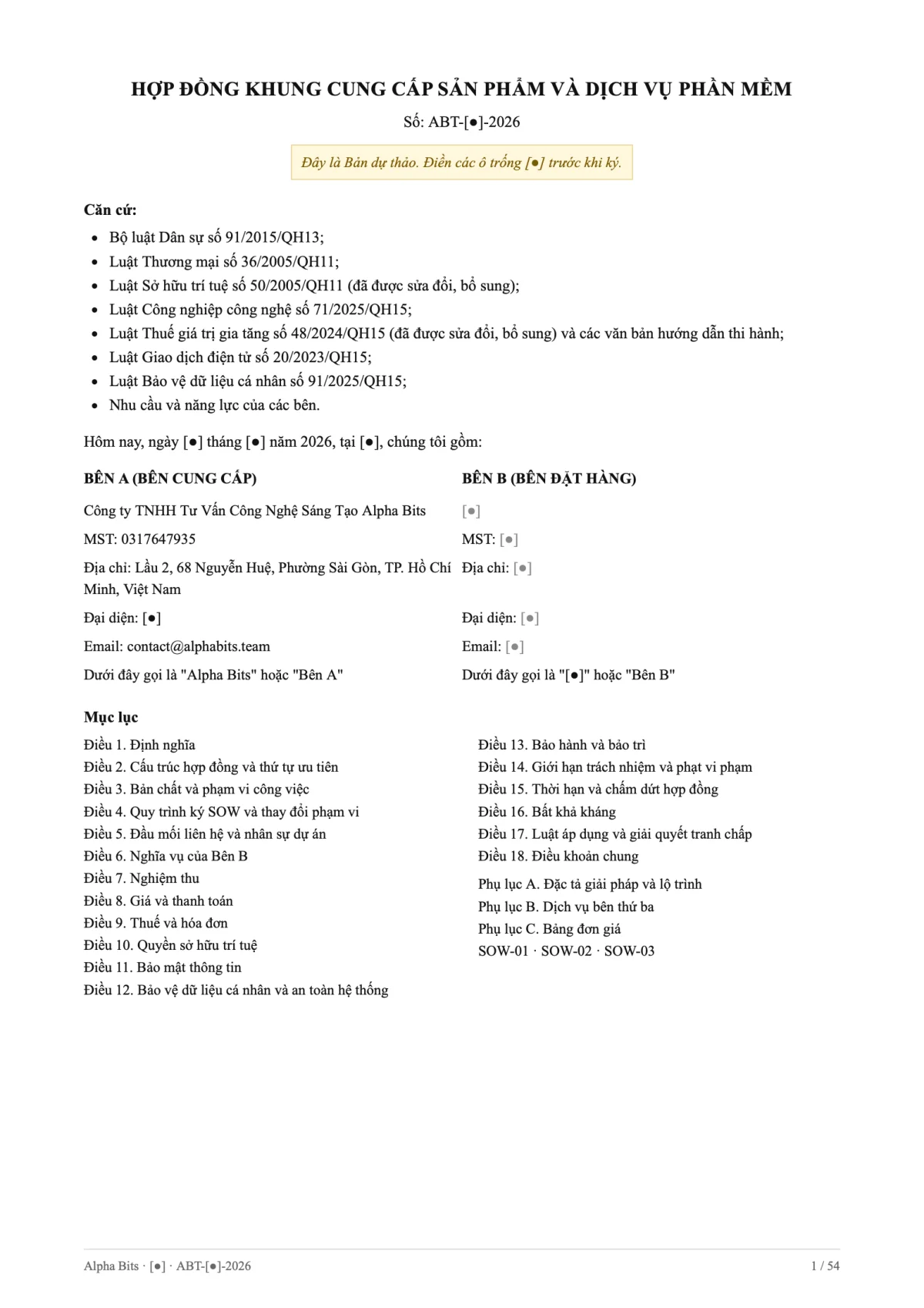
Opus 5.5 came out earlier this month. The first real job I gave it was something I would normally split between myself, an old template, a tax consultant and a lawyer: the proposal, the roadmap and the full software development contract for a new client. All in Vietnamese, for a Vietnamese company signing with my Vietnamese company, Alpha Bits.
The final contract pack came out at 50+ pages: a framework agreement, three appendices and three SOWs, one for each phase of the project. It went straight to the client's legal and finance team with no outside lawyer sitting in between.
Running a contract like a coding repo
Before anyone thinks this was one magic prompt before lunch, it took me a good week from start to finish, and it was nowhere near fully automated.
I ran the whole thing inside a project folder using our Konductor workflow, the exact same way we build software. Instead of handing Opus 5.5 an old contract template to copy, I asked it to gather the actual Vietnamese laws that govern a software development contract and draft straight from those texts.
Some of the legal documents it could fetch on its own. Others I had to go hunt down manually, especially the official appendix forms, and drop into the project folder myself. Every PDF we collected got parsed into clean Markdown (.md) and committed into docs/ so the model was referencing real versioned text instead of guessing article numbers from memory.
The list of laws that ended up on page one covers the full stack: Civil Code, Commercial Law, IP Law, the new Law on Digital Technology Industry, VAT Law 48/2024, E-Transactions Law and Personal Data Protection Law 91/2025.
Where AI caught things I would have missed
The tax section is where finance teams usually catch software agencies off guard. Software products and software services in Vietnam sit outside VAT under Article 5.21 of the VAT Law. Not a 0% rate, which is for exports, but not subject to VAT at all, so the e-invoice has to state "KCT" on the tax line. Opus 5.5 put that in its own article, wrote out the exact invoice wording, and added a clause covering what happens if the tax office ever interprets it differently later. That fallback clause I would never have thought to write myself.
Then came data privacy. The new Personal Data Protection Law 91/2025 is strict, and this platform stores student names, ID numbers, payment history and call recordings. I asked for proper Vietnam-compliant terms: the client is the data controller, we are the processor, all development and testing happens on staging with fake data, and nothing gets copied off their production server without written approval.
Payment terms went through the same grounding. Each SOW pays 30% when scope is locked, 30% when UAT passes and 40% on final acceptance, with 10% of the total held back until the warranty period ends. Late payment interest points straight to the right article in the Commercial Law. Every payout ties back to an acceptance milestone defined elsewhere in the contract, so there is much less grey area to fight over later.
Where I still had to step in
You still cannot hit generate and email a 50-page PDF to a client. A good chunk of that week went into reading every clause and rewriting parts that didn't fit how real projects run.
First, tone and wording. AI legal Vietnamese can sound overly stiff, and Opus 5.5 sometimes overthinks a straightforward commercial point into heavy paragraphs that make a client nervous for no reason. I went through and simplified a lot of those terms by hand. For technical keywords that sound awkward or confusing when forced into literal Vietnamese, we simply kept them in English.
Second, commercial boundaries. IP ownership came out reasonable on the first pass, while warranty obligations and change-request scope needed heavy human intervention. Those clauses are completely specific to the client, the team delivering the project and how much risk you are comfortable carrying. AI can tell you what the statute allows, it cannot tell you what breaks trust in a negotiation room.
What the client said, and why agency templates stay broken
When I sent the pack over, the client's legal and finance team definitely knew it came from AI. Even so, they came back with only a few line changes and barely any comments. Their one-line verdict: it's tight.
I have sent plenty of software contracts over the years, and that is the first time a first draft came back like that.
More often than not, the market norm for software agencies is still grabbing an old generic template that barely covers the basics, changing the company names and numbers, and hitting send. Nobody checks whether the laws quoted on page one are even still in force. The common assumption is that legal drafting belongs strictly to lawyers because it uses a different kind of language. In my past companies, long before AI was a thing, that meant consulting a tax person and a legal person separately for almost everything, losing weeks just passing redlines back and forth. Spending one focused week in a Konductor repo beats that old loop by miles.
I care more about compliance now
Honestly, I used to treat contracts as a necessary-but-mundane chore before the real engineering could start. Having a tool this capable sitting inside my workflow flipped that mindset.
Instead of copy-pasting a stale template, I actually took the time to learn how a commercial contract holds together: what belongs in the framework agreement, what goes into each SOW, and which article takes priority when two documents disagree. I decide the structure, the scope limits and the risk I'm willing to take. Opus 5.5 drafts the details and checks every article against the current laws sitting in docs/.
Keep your lawyer for high-stakes deals and actual disputes. Having said that, the days of signing a 50-page contract that nobody on either side properly read should be over.
Has anyone else sent an AI-drafted contract straight to a client's legal team? What did they say?