The Alterno Greenwashing Network: VCs, Shell Companies, and Serial Crowdfunding (SAND - Part 21)
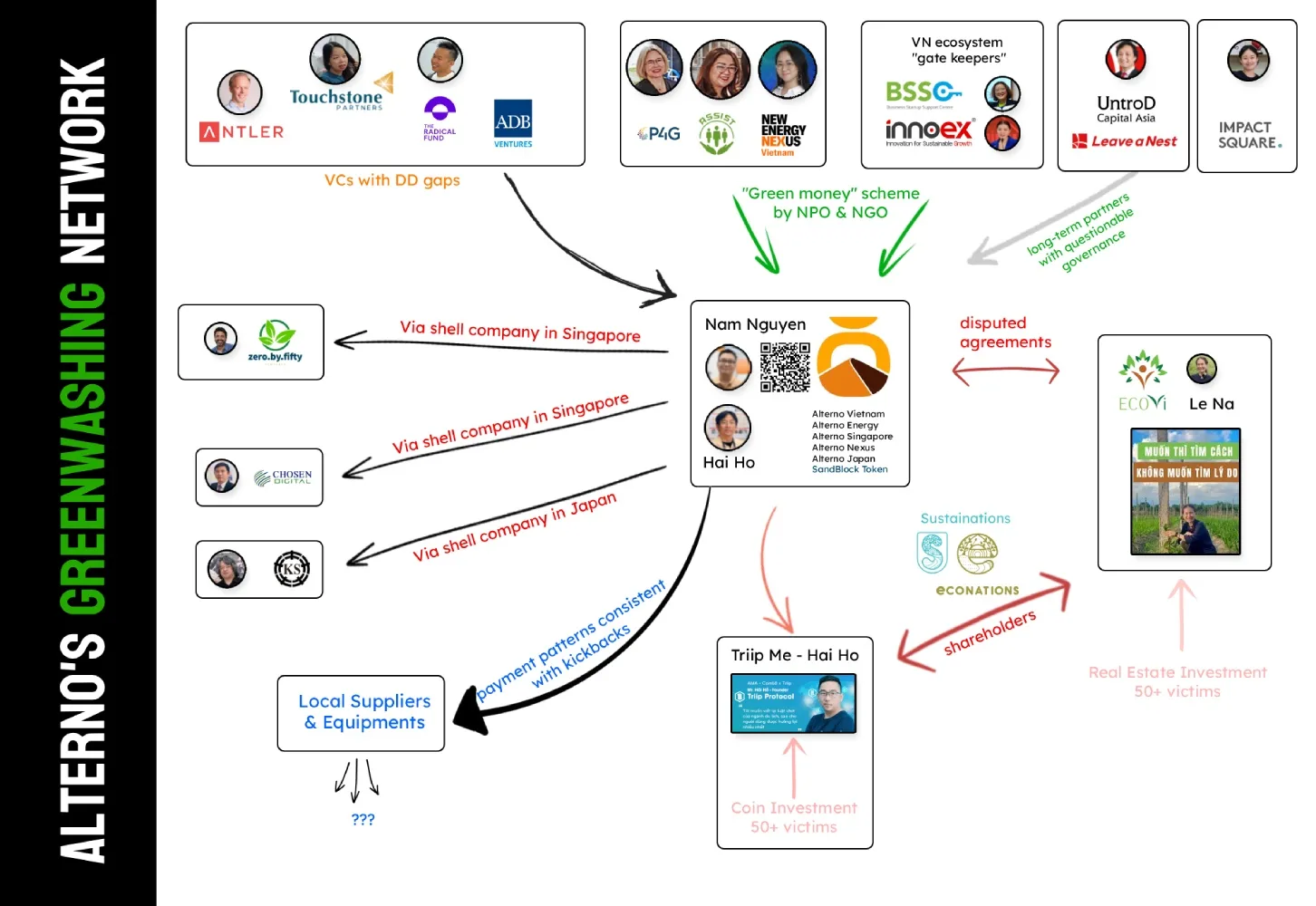
TL;DR: An analysis of Alterno's operational network reveals a complex web of entity routing, venture capital shields, offshore shell companies, and recurring crowdfunding vehicles. Far from being a single clean-tech hardware startup, the paper trail shows offshore control via Singapore's zero.by.fifty over Alterno Nexus, shell entities in Thailand (Chosen Digital) and Japan (KS), payment patterns consistent with supplier kickback loops, and systemic due-diligence gaps across VCs and NGO grant programs.
When investigating corporate disputes, PR narratives often obscure structural reality. Over the past several posts, an unfolding story of discovery has emerged: first, in SAND Part 19, we documented how management attempted an illegal corporate dissolution of Alterno Vietnam ("ve sầu thoát xác") to evade court summons and pending litigation. Next, in SAND Part 20, we exposed how they quietly launched SandBlock—a USDT crypto dApp built by external contractors—to bypass traditional VC due diligence and extract unregulated retail capital.
Here in SAND Part 21, the full picture comes into focus. SandBlock was not an isolated crypto experiment, nor was the domestic dissolution an ordinary corporate decision. They are connected nodes in a broader, multi-year greenwashing and capital-routing network. By synthesizing corporate registry filings, public court records, and internal network maps, we can now expose how CEO Hai Ho and CTO Nam Nguyen operate within a web of VC shields, NGO grants, offshore shell entities, and recycled crowdfunding syndicates.
1. The Entity Web: Evading Vietnamese Law via Offshore Shells
To the public and prospective investors, Alterno presents itself as a unified Vietnamese climate-tech startup pioneering sand-battery thermal storage. Behind this storefront lies a fragmented multi-jurisdictional entity structure whose shape is consistent with capital routing, liability shielding, and asset stripping.
The storefront itself is worth a close look. As of July 2026, the flagship Alterno Air 2 Sand Battery product page on alterno.net still carries a 2024 copyright footer and displays 20 customer reviews — every one rated exactly 5 stars, every one tagged "verified owner." The review texts are generic one-liners repeated verbatim across different reviewers ("Very well worth the money," "Good quality," "Good service," "Very fast delivery"), each carrying a stray "1 product" template artifact — hallmarks of placeholder e-commerce demo content rather than real customer feedback. Most telling: the page lists no price and offers no checkout, only a "Register to Buy Now" inquiry form. A product that cannot be purchased through the site cannot, by definition, generate verified-owner purchase reviews. For a company that raised institutional capital on the strength of commercial traction, the public face of that traction appears to be an unmaintained template.
As documented in detail in SAND Part 19 (The Lawsuit Timeline & Document Discrepancies), management attempted an illegal corporate dissolution of Alterno Vietnam under Vietnamese Law. Under the Law on Enterprises (No. 59/2020/QH14), initiating corporate dissolution while actively embroiled in court litigation, unresolved shareholder disputes, or pending debt claims is strictly prohibited. The offshore network mapped out here explains the underlying motive for this maneuver:
- Alterno Nexus (Singapore): Operating as an offshore holding and capital vehicle in Singapore,
Alterno Nexusis directly controlled byzero.by.fifty, a Singapore-registered corporate entity—shifting primary corporate control and investor funds far outside Vietnamese court jurisdiction. - Chosen Digital (Thailand): Capital and operational agreements route through
Chosen Digitalin Thailand, which appears to function as an external proxy through which operational cash flows are routed. - KS (Japan): An additional international entity footprint established in Japan (
KS), expanding the multi-country routing loop. - Local Supplier Payment Patterns: On the domestic operations front, payment records for local equipment and suppliers show patterns consistent with inflated invoicing, raising the question of whether capital was stripped from Alterno Vietnam before any potential court asset-freezing orders could take effect.
The Full Entity Roster
Laid out in one place, the network map above documents at least six vehicles operating under the "Alterno" umbrella, alongside the external entities they connect to:
| Entity | Jurisdiction | Role in the Structure | Status / Notes |
|---|---|---|---|
| Alterno Vietnam JSC | Vietnam | Original operating company; defendant in the wrongful termination lawsuit | Subject of the contested dissolution resolution of May 24, 2025 (Part 19) |
| Alterno Energy | Vietnam (Da Nang) | Replacement domestic entity | Registered April 11, 2025 — four days before a scheduled court appearance (Part 19) |
| Alterno Singapore | Singapore | Offshore operating footprint | Distinct from the Nexus holding vehicle |
| Alterno Nexus | Singapore | Offshore holding and capital vehicle | Controlled by zero.by.fifty |
| Alterno Japan | Japan | International entity footprint | Connected to the KS entity |
| SandBlock Token | On-chain (USDT) | Retail crypto crowdfunding vehicle | Built by an external contractor proxy (Part 20) |
zero.by.fifty | Singapore | Corporate controller of Alterno Nexus | Shifts ultimate control outside Vietnamese jurisdiction |
| Chosen Digital | Thailand | External proxy for capital and operational agreements | Appears to function as a routing conduit for operational cash flows |
KS | Japan | External entity in the routing loop | Counterparty of the Japan footprint |
| Triip Pte. Ltd | Singapore | Hai Ho's prior crypto venture (TriipMiles ICO) | Self-listed as active since 2014 on Hai Ho's LinkedIn profile |
2. Institutional Enablers and Gatekeeper Blind Spots
A central question in startup forensics is how high-risk corporate structures gain mainstream legitimacy. Alterno successfully leveraged three tiers of ecosystem gatekeepers, none of whom appear to have performed rigorous multi-entity due diligence:
Venture Capital Governance Failures
Prominent regional VC funds—including Antler, Touchstone Partners, The Radical Fund, and ADB Ventures—provided seed backing and public validation. Despite marketing rigorous governance standards, these funds appear to have overlooked overlapping offshore entities and parallel crypto tokenization efforts.
NGO & Non-Profit "Green Money" Grant Pipelines
Non-profit and NGO grant bodies—such as P4G (Partnering for Green Growth), ASSIST, and New Energy Nexus Vietnam—funneled non-dilutive "green money" into the company. These grants served to burnish Alterno's environmental credentials while capital was simultaneously exposed to unregulated web3 schemes.
Ecosystem Gatekeepers
Incubators and institutional platforms like BSSC (Business Startup Support Centre), Innoex, UntroD Capital Asia (Leave a Nest), and Impact Square acted as regional amplifiers, providing awards, public stages, and policy access without auditing back-end governance integrity. Hai Ho's own LinkedIn profile also lists a Member of the Board of Advisors seat at the Austria-Vietnam Innovation Council — one more institutional credential lending legitimacy to the network.
Unanswered Questions for VCs, Grant Bodies, and Gatekeepers
The public record raises legitimate process questions for the investment committees, grant bodies, and ecosystem platforms whose logos appear on Alterno's pitch decks:
- What Due Diligence Was Performed Before the Round Was Announced? During the March-July 2024 window between term sheets and the public funding announcement, what multi-entity due diligence did the participating funds—Touchstone Partners, The Radical Fund, and Antler—actually perform? How did they factor into the decision to proceed?
- What Standards Govern Ecosystem Endorsements? Platforms like BSSC and InnoEx continue to provide public stages and promotion to Alterno's new corporate entity while the original Vietnamese entity is subject to active court proceedings and a contested dissolution. What verification, if any, do these platforms perform on the legal standing of the companies they endorse? Should endorsement of a restructured vehicle during pending litigation meet a higher bar?
- What Conflict-of-Interest Disclosures Apply? What conflict-of-interest and disclosure policies govern deal leads, program managers, and advisory board members at VC funds and gatekeeper organizations (BSSC, InnoEx, Impact Square, UntroD) when steering grant allocations and startup awards? Are those disclosures published anywhere the public can verify?
- How Were "Green Money" Grants Audited? What audit mechanisms did grant managers at P4G, ASSIST, and New Energy Nexus Vietnam use to verify that non-dilutive grant funds were deployed on real climate hardware rather than absorbed into the opaque supplier payment patterns described above?
- What Was the Governance Response to SandBlock? When Alterno launched
SandBlockto solicit unregulated USDT investments from retail users—built by the same external contractor proxy used in Hai Ho's pastTriip.mecrypto venture—were institutional board members aware? If so, what governance response, if any, followed? - Who Bears Responsibility If Retail Pools Default? Institutional prestige lent to an unverified corporate structure helps retail investors trust adjacent crowdfunding vehicles (EcoVi, Sustainations, SandBlock). If those retail pools default, what responsibility do the endorsing institutions accept, and what would regulators expect of them?
3. The Recycled Web3 and Crowdfunding Ecosystem
The establishment of SandBlock in 2026 is part of a long-standing operational playbook executed by CEO Hai Ho. Notably, none of this requires leaked documents to establish — Hai Ho's own self-published LinkedIn profile lists these roles as concurrent: full-time CEO of Alterno (July 2024–present), Chairman of Sustainations DAO (March 2022–present), and Chairman of Triip Pte. Ltd in Singapore (December 2014–present). The Singapore entity behind the TriipMiles ICO is not a closed chapter; it remains listed as an active, current position. A cross-examination of these ventures reveals a recurring reliance on retail crowdfunding pools when institutional capital encounters friction:
- Triip.me & Triip Protocol: Prior to Alterno, Hai Ho led Triip.me, which launched the TriipMiles token ICO. The project left over 50 retail investors facing unfulfilled financial claims.
- Sustainations DAO: Marketed as a "web3 private community built on Internet Computer Protocol (ICP)," Sustainations served as a bridge linking web3 crowdfunding to green initiatives under Hai Ho's chairmanship. Its public Sustainations Vietnam page counts roughly 6,000 followers — a measurable retail audience for its pitches.
- EcoNations (Nông Trại Cộng Đồng): A web3, IoT, and AI-themed agricultural crowdfunding platform pitching community-funded green farming projects, with a public following of roughly 5,600 accounts.
- EcoVi / Le Na Real Estate Syndicate: Disputed partnership agreements tied EcoVi / Le Na to the broader network; more than 50 real estate investors are reported to be seeking legal redress over unpaid capital and default claims.

Conclusion: The Structural Purpose of the Offshore Web
Greenwashing in the modern tech ecosystem is no longer restricted to exaggerated carbon offset claims. It has evolved into a sophisticated corporate architecture where institutional VC credentials, non-profit grants, offshore holding companies, and retail crypto schemes reinforce one another.
The entity map documented in this article explains the strategic motive behind the events documented in SAND Part 19: the illegal attempt to dissolve Alterno Vietnam while litigation and shareholder claims were actively pending. By routing operations, capital, and IP agreements into Singapore (zero.by.fifty / Alterno Nexus), Thailand (Chosen Digital), and Japan (KS), management positioned itself to move value out of Alterno Vietnam and leave domestic legal liabilities behind.
When startup founders combine illegal corporate dissolution attempts in their home jurisdiction with unregulated crypto dApps like SandBlock (SAND Part 20), the risk falls entirely onto retail backers, creditors, and legitimate climate-tech innovators.
As court proceedings in Vietnam progress, establishing an unshakeable, public paper trail remains paramount. Discernment requires looking past press releases, inspecting corporate registries across jurisdictions, and holding both management and institutional gatekeepers accountable to the rule of law.