Your Blog Should Be an AI-Powered Second Brain, Not a Newsletter
I have been publishing online since the early 2000s. Over the last two decades, I built publications on almost every blogging engine and newsletter service available: custom PHP scripts, WordPress, Ghost, Medium, and Substack. For years, the industry repeated the same dogma: build a newsletter list, capture emails, and blast updates to an audience.
In 2026, in the age of long-context AI coding assistants and Answer Engines, that advice is completely backwards. Newsletters are disposable broadcasts; your writing should be an externalized, queryable Second Brain.
When you publish on a rented platform, every article is an isolated broadcast that decays within 48 hours. When you build a sovereign blog inside a Git repository alongside your private technical notes and architecture decisions, your writing turns into an active intellectual sparring partner that gets sharper with every commit.
1. The Newsletter Trap: Ephemeral Broadcast vs. Compounding Intelligence
The newsletter model is an assembly line. You write an email, blast it to thousands of inboxes, and two days later it effectively ceases to exist. It sits buried in email archives, disconnected from your other ideas. When it is time to write the next piece, you start over from a blank page with zero cumulative intelligence.
This creates a hamster wheel where creators are forced to constantly produce disposable commentary to keep subscriber numbers from churning.
A sovereign Second Brain operates on compound interest instead:
- Persistent Knowledge Base: Behind this public website sits a private Git repository containing decades of project notes, hardware schemas, litigation dockets, and architecture decision records (ADRs).
- Full-Corpus AI Ingestion: Modern frontier models (Gemini, Claude, GPT) easily ingest the entire multi-million-token codebase in a single prompt. The AI understands my background as a founder, my hardware inventions, my legal disputes, and my architectural philosophy before I write a single word.
- Continuous Sparring: When I explore a new idea, I do not write into a blank void. My AI agent references twenty years of my past writings, cross-checks my factual claims, challenges my assumptions, and helps synthesize the core argument.
2. The Walled Garden Myth: Why Hosted Platforms Fail in the AI Era
Platforms like Substack and Medium promise two things: built-in discovery and simplicity. In practice, both promises have broken down in the modern web ecosystem.
First, hosted platforms introduce severe geographical and technical vulnerabilities. Medium has been blocked by major internet service providers across Southeast Asia (including Vietnam) for years. If I publish an analysis on Medium, a huge portion of my network and regional developers cannot load the page without configuring a custom VPN or changing their DNS resolvers.
Second, hosted platforms are increasingly hostile to Answer Engine Optimization (AEO). Modern discovery is shifting toward AI search engines like Perplexity, ChatGPT Search, Claude, and Gemini. When an AI crawler encounters a Medium paywall, cookie banner, or heavy client-side JavaScript bundle, it often struggles to ingest and accurately cite the underlying text.
My sovereign site runs on a $5 virtual private server (VPS) behind Cloudflare edge caching. It serves clean, semantic HTML alongside structured llms.txt and llms-full.txt endpoints. Pages load globally in under 50 milliseconds, and AI search engines can index and cite the canonical source without encountering paywall roadblocks.
3. The IDE is the CMS
Traditional content management systems (CMS) add friction that slows down serious writing. You fight with web-based WYSIWYG editors, clean up broken image formatting, and manage draft sync issues in a browser tab.
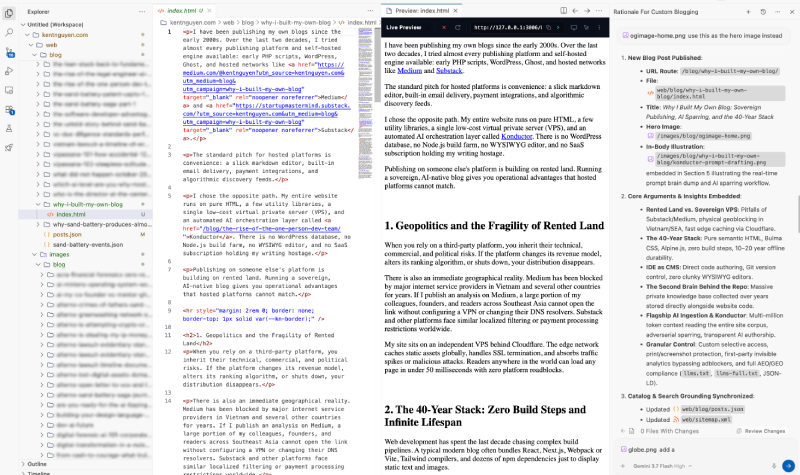
On this site, there is no admin portal. My editor is my code editor (VS Code / Antigravity IDE). An article is simply a file in the Git repository. Adding an image is dropping an asset into a folder. Linking to past research is a standard relative file path. Every edit is tracked with full Git commit history, branching, and instant rollbacks.
To complete the sovereignty loop, even the Git remote is self-hosted. Instead of handing my private Second Brain, unpublished research, and raw project notes over to Microsoft's GitHub, I run a self-hosted Gitea instance on a cheap private VPS. Escaping the GitHub monopoly ensures that my writing, version history, and personal knowledge base remain strictly under my own keys and control.
4. The 10/90 Rule: Radical Transparency in AI Writing
Many writers in tech quietly use AI tools to draft content, but hide it out of fear of being labeled as generating "AI slop." The backlash against AI content is justified when someone publishes raw, generic ChatGPT summaries with zero human substance.
The antidote to AI slop is not avoiding AI; it is enforcing the 10/90 rule:
- 10% Human Battle Scars (The Soul): You cannot synthesize lived experience. The core insights come from real founder trauma: launching businesses on Windows 3.11 with FoxPro, building hardware prototypes in Bao Loc tea factories, surviving cross-border litigation, and sitting twelve days of silent Vipassana.
- 90% AI Sparring and Execution (The Engine): You feed raw, unstructured brain dumps into your agent. The AI challenges your logic, structures the narrative sequence, drafts semantic HTML, and cross-references your codebase history.
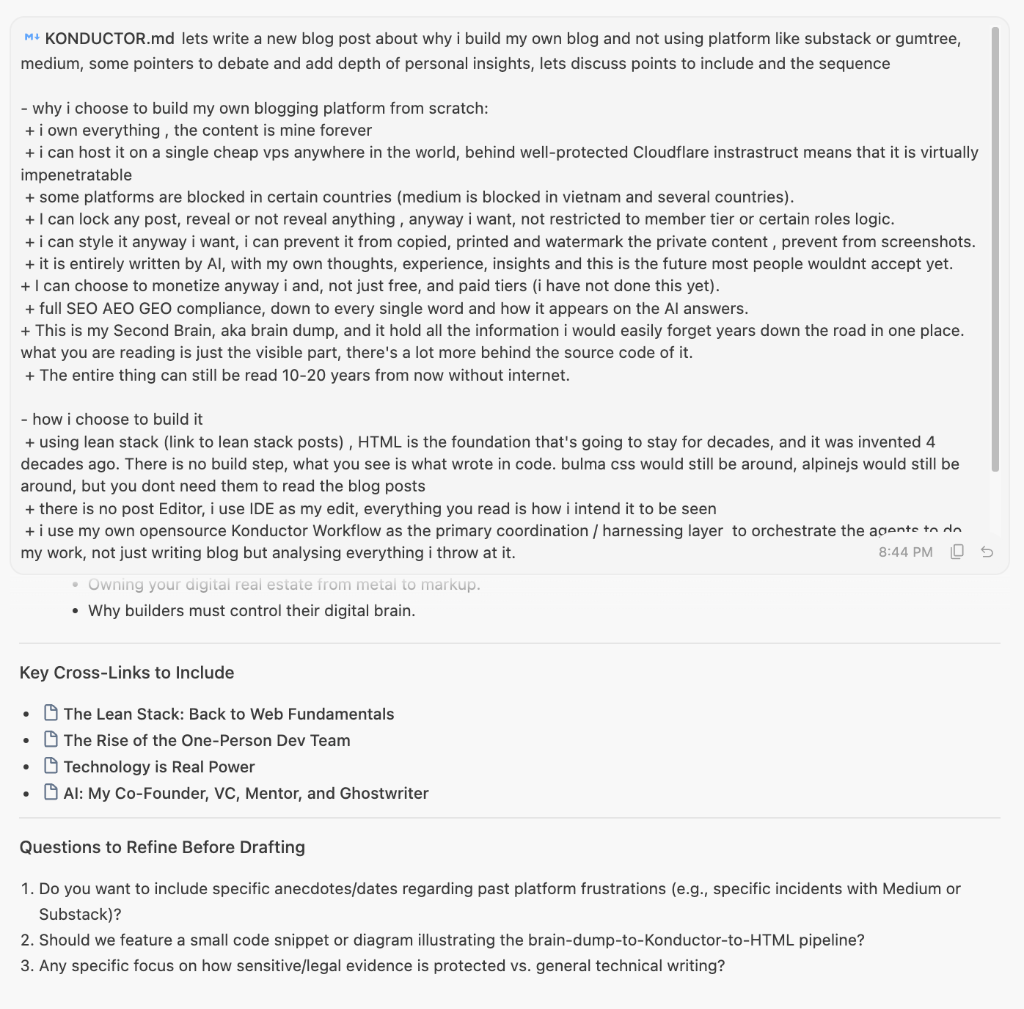
This article itself was authored through this exact process. The thoughts, technical philosophy, and lived lessons come directly from my career; the prose structuring, HTML formatting, and humanizer filtering are orchestrated by AI agents running in Konductor.
5. The 40-Year Stack: Zero Build Steps and Infinite Durability
Most modern web publications are over-engineered. They bundle React, Next.js, Webpack, Tailwind compilers, and hundreds of npm packages just to render text on a screen. Every extra dependency starts a countdown clock toward build breakage and unmaintainable legacy code.
As I outlined in Why the Best AI Tech Stack Is from 1995, returning to web primitives creates indestructible software:
- Semantic HTML: The most durable data specification in history. What you write in the HTML file is what the browser displays.
- Bulma CSS: Clean, responsive layout styling without runtime JavaScript dependencies.
- Alpine.js: Lightweight reactive interactivity declared directly in HTML attributes when dynamic behavior is needed.
- Bun and SQLite: Instant backend execution and local database storage without server daemon complexity.
There is no compilation pipeline. If you download this repository to a flash drive, disconnect from the internet, and open an article in 2056, it will render exactly as intended in any browser.
6. The Prototype Trap: Why Builders Must Own Their Domain
Thousands of developers and founders are using tools like Lovable, Bolt, v0, and Google AI Studio to build working software in minutes. Yet many leave their applications hosted on default subdomains like .lovable.app or .vercel.app.
If generative AI makes writing code fast and inexpensive, owning your distribution infrastructure is the only permanent advantage left. Exporting your code, running it on your own server, and attaching your own domain converts temporary prototypes into sovereign digital real estate.
Build an Engine, Not a Megaphone
The early web was built on personal sovereignty and decentralized nodes. Corporate platforms spent fifteen years convincing writers to trade that sovereignty for the illusion of convenience and algorithmic distribution.
With modern AI assistants and native web primitives, running your own platform is easier than ever. Stop shouting into the void of disposable newsletters. Build a sovereign knowledge engine that sharpens your thinking and preserves your intellectual work for decades.